2025.10.273 min read
AI MemoryVector Search
Cognia: Enterprise Memory Infrastructure
A decentralized memory layer that captures, indexes, and recalls your digital actions with complete local control and privacy.
byViraj Bhartiya
on this page14
A decentralized memory layer that captures, indexes, and recalls your digital actions with complete local control and privacy.
Architecture
- Browser Extension captures web content automatically
- Each page becomes a Memory Object hashed, summarized, and vectorized using Google's text-embedding-004 model
- Objects are stored in PostgreSQL with pgvector embeddings
- Semantic search engine maps queries to content via cosine similarity
- Any device or agent can request recall by wallet address
Memory Enforcement
- Data cannot mutate
- No "edit memory" endpoint
- Updates spawn new hashes, old ones remain
- Memory is verifiable, not curated
Search System
- Query hits vector database
- Similarity scores calculated via pgvector cosine distance
- Results ranked by blended keyword + semantic scores (60% semantic, 40% keyword)
- AI answers generated with inline citations
Similarity Score Calculation
1. Cosine Similarity (Primary)
typescript
cosineSimilarity(vecA: number[], vecB: number[]): number {
  let dotProduct = 0;
  let normA = 0;
  let normB = 0;

  for (let i = 0; i < vecA.length; i++) {
    dotProduct += vecA[i] * vecB[i];
    normA += vecA[i] * vecA[i];
    normB += vecB[i] * vecB[i];
  }

  return dotProduct / (Math.sqrt(normA) * Math.sqrt(normB));
}
2. Domain-Aware Adjustments
- Penalty: Meet ↔ GitHub cross-links get -0.4 similarity unless very high (>0.7)
- Boost: GitHub ↔ GitHub Filecoin-related items get +0.2 similarity
- URL Matching: Same domain gets +0.1 similarity boost
3. Keyword Matching (Secondary)
typescript
// Token-based matching with word boundaries
for (const token of queryTokens) {
  const tokenRegex = new RegExp(`\\b${token}\\b`, "gi");

  if (tokenRegex.test(title)) keywordScore += 0.5; // Title weight
  if (tokenRegex.test(summary)) keywordScore += 0.3; // Summary weight
  if (tokenRegex.test(content)) keywordScore += 0.2; // Content weight
}

// Normalize by query token count
keywordScore = keywordScore / queryTokens.length;
4. Final Hybrid Score
typescript
const hybridScore = semanticScore * 0.6 + keywordScore * 0.4;
const boostedScore = hybridScore * (1 + coverageRatio * 0.3);
5. Topical Relations (Metadata-Based)
- Topic Overlap: 40% weight using Jaccard similarity
- Category Overlap: 30% weight
- Key Points Overlap: 20% weight
- Searchable Terms: 10% weight
6. Temporal Relations (Time-Based)
- Same Hour: 0.9 + exponential decay
- Same Day: 0.7 + exponential decay
- Same Week: 0.4 + exponential decay
- Same Month: 0.1 + exponential decay
What It Can Store
- Web pages (via browser extension)
- Manual content (via web client)
- SDK integrations
- MCP server connections
Requirements:
- Runs through the API
- Doesn't rely on external state or timing
- Can be vectorized and searched
Local Control with Ollama
- Local AI Processing: All AI operations can run through Ollama models
- Zero External Dependencies: No cloud APIs required
- Privacy by Design: Data stays on your machine
- Offline Capable: Full functionality without internet
- Model Flexibility: Use any Ollama-compatible model
Technical Stack
- Storage: PostgreSQL with pgvector
- AI: Google Gemini API with Ollama local support
- Embeddings: text-embedding-004 (768-dimensional vectors)
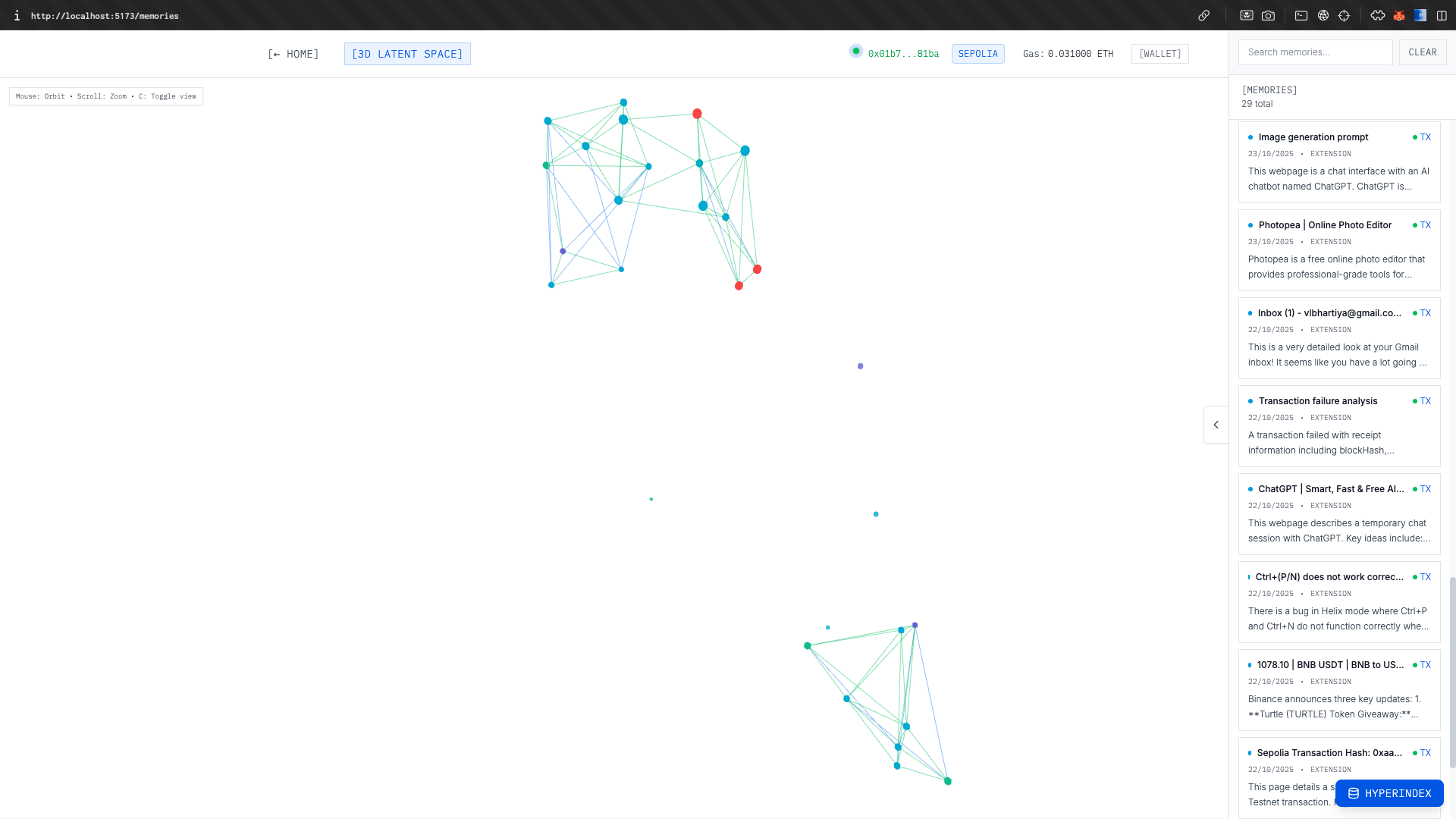
- Frontend: React with Three.js for 3D visualization
- Extension: Chrome extension with content script injection
- Visualization: UMAP for latent space projection
Tooling
- Browser Extension: Captures web content automatically
- Web Client: React app with 3D memory mesh visualization
- API Server: Express.js with PostgreSQL + pgvector
- SDK: TypeScript client for programmatic access
- MCP Server: Model Context Protocol integration for AI agents