What if prediction markets were actually simple?
I stripped away order books, liquidity pools, and AMM curves. Built a prediction market that fits on a grid. Here's how it works.
on this page7
What if prediction markets were actually simple?
Every prediction market I've tried made me feel stupid.
Order books. Liquidity pools. AMM curves. Slippage. Impermanent loss. You need a finance degree just to place a bet on whether ETH goes up or down in the next 5 minutes.
I'm a builder. I kept staring at these interfaces thinking... why is this so hard? The core idea is dead simple. You think a price is going somewhere. You put money on it. You're right or you're wrong.
So I stripped everything away and built Blip Markets.
And the whole thing fits on a grid.
The grid
Imagine a spreadsheet overlaid on a price chart.
Rows are price ranges. Columns are time windows. Each cell is one prediction: will ETH touch $3,510-$3,515 between 2:05 and 2:06 PM?
That's it. That's the whole interface. No charts to analyze, no indicators to configure, no order types to memorize. You look at the grid, you pick a cell, you place a stake.
The grid shows you everything at a glance. Where the price is now. Where it's been. Which cells are still open. Which ones are about to close.
You don't need to understand candlesticks or RSI or Bollinger Bands. You just need an opinion on where the price goes next.
How you make money
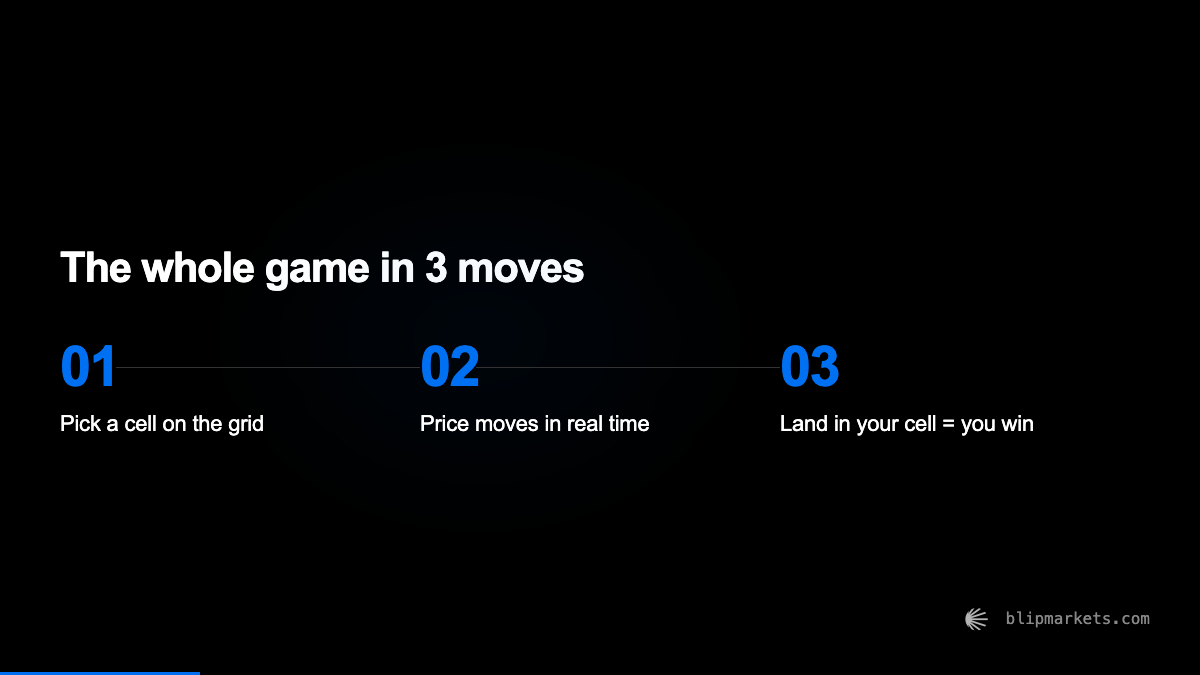
You pick a cell. You stake. If the price touches your range during that time window, you win.
That's the entire flow. Three steps.
The payout depends on how bold your prediction is. A cell right next to the current price might pay 2x. A cell further out? 10x. 20x. The further from the current price, the bigger the payout, because it's less likely to hit.
But here's what I care about most: the pricing is mathematically fair. Every cell is priced at its actual probability of hitting, calculated using the same math behind barrier options in traditional finance. No house edge baked into the odds.
You're not betting against the house. You're betting on your ability to read the market better than the model does.
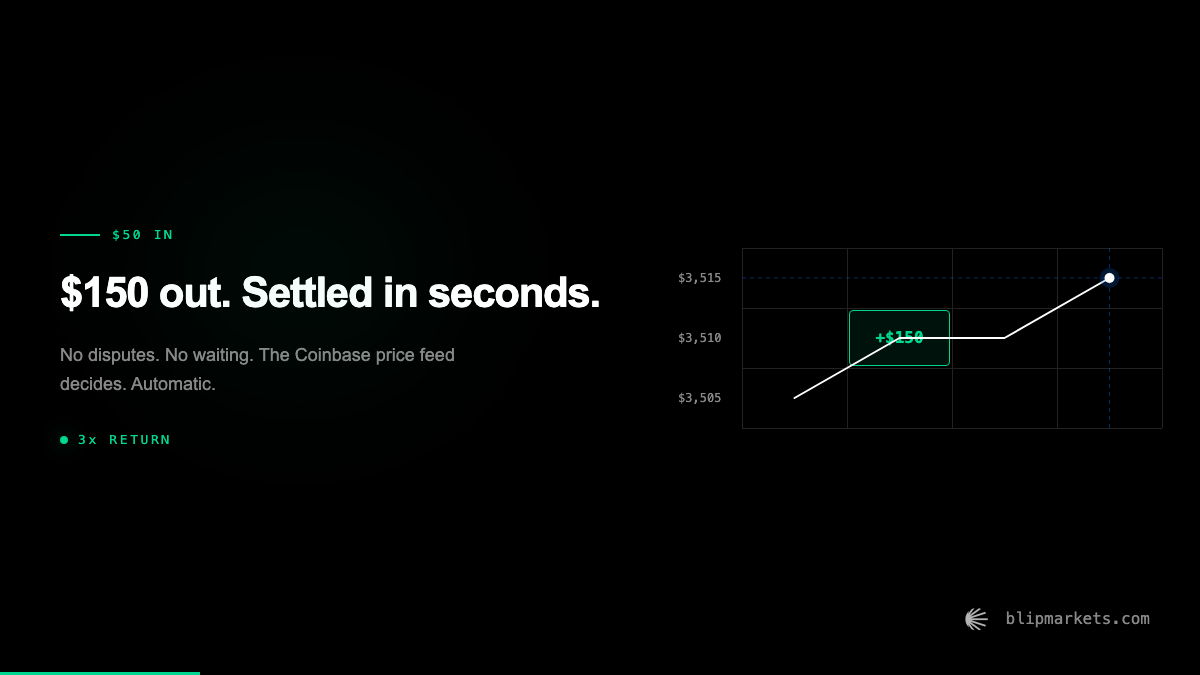
$50 in. Price touches your cell. $150 out. Settled in seconds. No disputes. The Coinbase price feed is the only judge.
You can see where everyone else is betting
This is my favorite part.
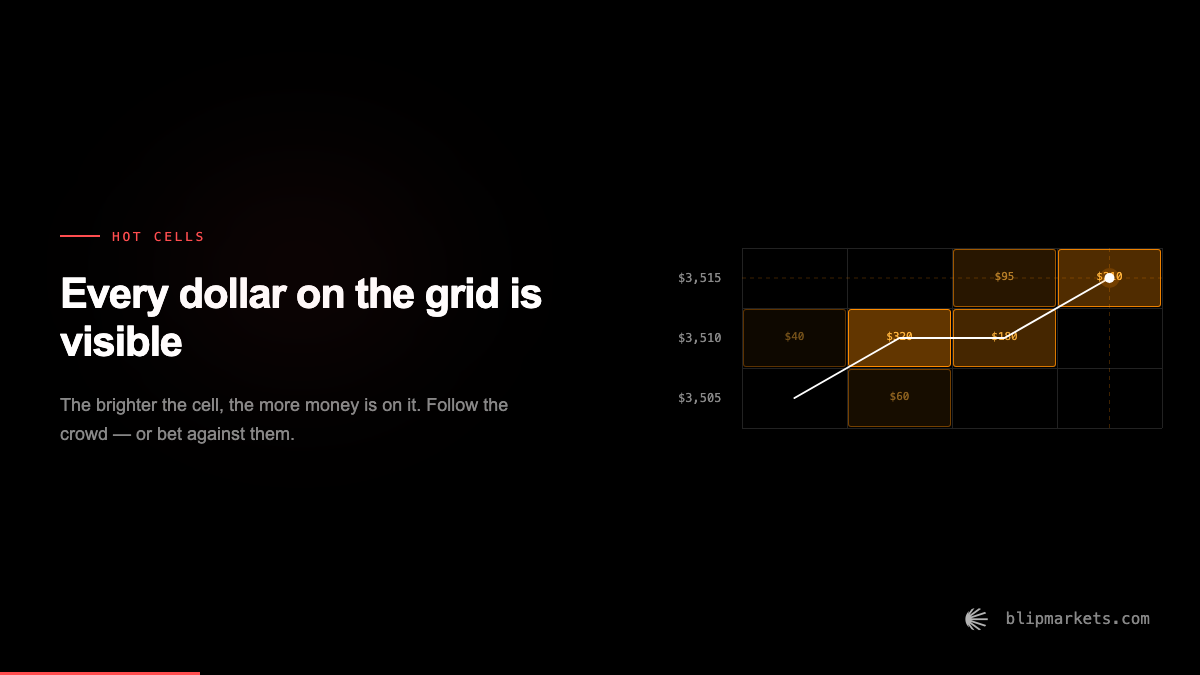
The grid has a live heatmap. When someone stakes on a cell, it lights up orange. More money on a cell = brighter the glow. We call them Hot Cells.
So you're not trading blind. You can see exactly where the money is flowing. In real time. Every dollar is visible on the grid.
There's a panel that ranks the top 5 hottest cells with their stakes, probabilities, and multipliers. You can even one-tap copy someone else's bet.
Use it as signal. Use it as counter-signal. It's up to you. But the information is there, and it changes how you think about every prediction you make.
You don't have to risk anything to try it
I didn't want to build something where people show up, lose money on their first bet because they don't understand the grid, and never come back.
So practice mode exists.
Same grid. Same real-time Coinbase prices. Same settlement logic. The only difference: you're using free tokens. 500 of them, every day, automatically.
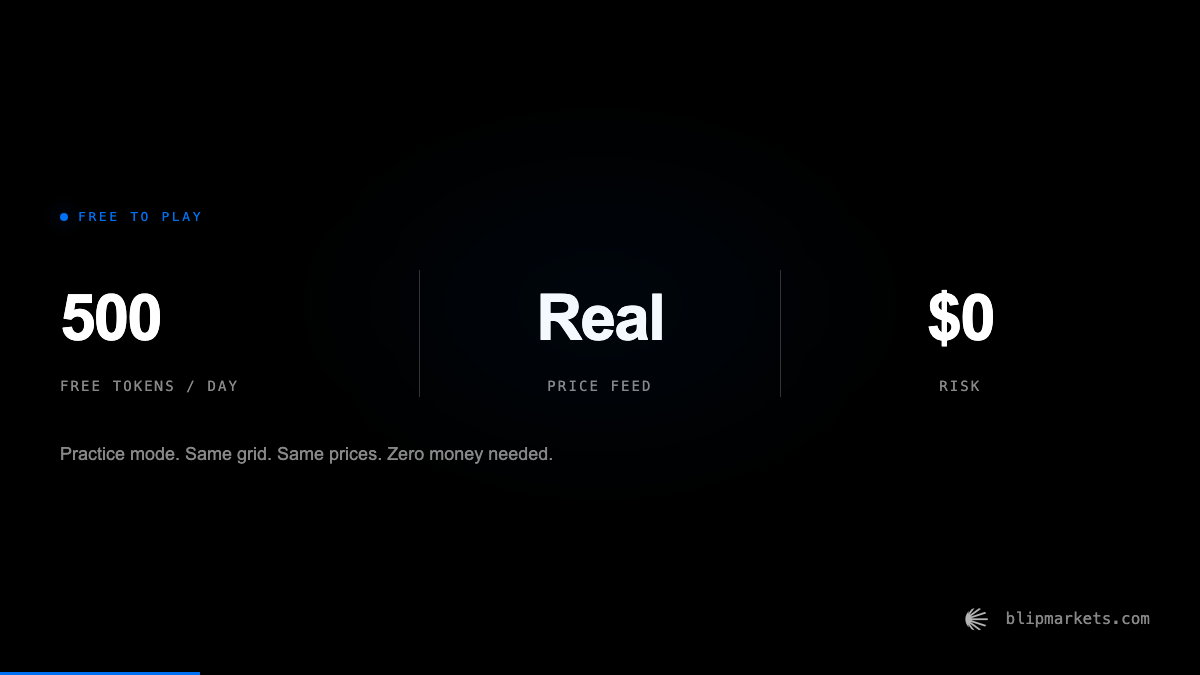
Learn how the grid moves. Get a feel for how probability pricing works. Figure out whether you're the type to bet tight ranges for big payoffs or wide ranges for safer wins. Then, when you're ready, switch over.
No one's rushing you.
Contests (coming soon)
Solo trading is fun. But competing against other traders on the same grid, during the same time window, with a live leaderboard? That's a different kind of rush.
Contests have set start and end times. Everyone starts at zero. The leaderboard tracks net PnL in real time. When it's over, top traders take the prizes.
And after every contest ends, there's Replay Mode. You can scrub through the entire contest, watch every price movement, see every cell settle, and figure out what you could've done differently. It's game film for prediction markets.
Practice mode is the best way to get ready.
Why I built this
It started at ETHGlobal HackMoney. I built the first version of Blip Markets during the hackathon, won, and became an ETHGlobal finalist. That validation told me the idea had legs.
But the hackathon prototype was rough. I wanted a prediction market my friends could actually use.
Not the friends who already trade options. The ones who check the ETH price 10 times a day but never do anything with that knowledge. The ones who say "I knew it was going to go up" after every move but have no way to act on it.
The grid gives them a way. Look at the price. Pick a range. Put something on it. Know in 60 seconds if you were right.
That feedback loop (prediction, outcome, learn, repeat) is what makes this addicting. And doing it with real-time prices on a visual grid makes it feel less like trading and more like a game you actually want to play.
Try it
The grid is live. Practice mode is free. Contests are on the way.
blipmarkets.com